The sheer scale of Mexican artist Diego Rivera’s Detroit Industry Murals (1932–1933) is incredible: 27 fresco panels, full of movement and color, cover the room’s 55-foot-high walls. Visitors are surrounded by towering figures and tiny vignettes, Aztec deities and white-coated scientists, and line workers in a factory. Everywhere you look, there’s another story to discover.
Next time you’re at the DIA, look closely at the murals and discover new stories. Here are five often-overlooked details that many visitors miss. (Not that we blame you—it’s a lot to take in!) Follow along with this interactive web experience, generously supported by the Knight Foundation, that transports you to Rivera Court and lets you explore the murals up close.

1. Real Detroiters (and Rivera himself)
Rivera included everyone from workers to Detroit leaders—and even pop culture figures. The North Wall alone contains 12 portraits, including a few of Rivera's assistants and two DIA employees. Rivera himself appears in a bowler hat among factory workers with, notably, green skin. (More on that in detail No. 2.)
Influential Detroiters appear on the South Wall. Henry Ford appears in a lower middle panel, instructing a class about the V-8 engine (although he was never actually a teacher). In the far-right corner, you’ll find his son, Edsel Ford—president of both Ford Motor Company and the Arts Commission of the City of Detroit at the time—alongside William Valentiner, the DIA’s director from 1924 to 1945. M.L. Bricker, an important Ford production manager known for speeding up the assembly line, appears as a stern foreman in the bottom left.
Also on the South Wall are pop culture cameos, including popular 1930s actress Jean Harlow, as well as comic strip characters of the time like Dick Tracy and the Katzenjammer Kids, seen touring the factory. Using comic characters was Rivera’s way of “making fun of the visitors who had the time to get dressed up and come and watch other people work and sweat,” says Marge Fein, who has been a DIA docent for nearly 20 years.
Left: M.L. Bricker, an important Ford production manager known for speeding up the assembly line, appears as a stern foreman, and, below, Henry Ford instructs a class about the V-8 engine (although he was never actually a teacher). Right: Edsel Ford—president of both Ford Motor Company and the Arts Commission of the City of Detroit at the time—alongside William Valentiner, the DIA’s director from 1924 to 1945, holding the contract for the murals.
2. A Critique of 1930s Working Conditions and Segregation
Green-faced workers on the North Wall highlight poor working conditions. Rivera includes himself—also painted with a green face—among that group, showcasing sympathy.
“Rivera was referring to the fact that aspects of building cars gave off toxic fumes, and some workers may have gotten sick because of that,” says Denise Gimpel, a DIA docent who gives about 100 tours of Rivera Court each year. “Today we have OSHA standards, but at that time, there were no federal regulations.”
Four men of different races stand around a machine on the North Wall, but segregation was alive and well in 1930s Detroit. “The factory that the artist showed us was in many ways idealized,” says Benjamin Colman, DIA Curator of American Art.
We know from historical records that the workforce at the Rouge plant was deeply segregated along racial lines. So, where the artist shows us a racially integrated workforce, we know that he's using an optimistic gaze to show the world as he wanted it to be, rather than the world that he saw.
Left: Rivera included himself, wearing a bowler hat, among the green-faced workers (middle, left). Right: Four men of different races stand around a machine on the North Wall, but segregation was alive and well in 1930s Detroit.
3. More Than Just Cars: A Whole City of Industries
While the Detroit Industry Murals are largely known for their depiction of auto workers, Rivera captures how Detroit served as a hub for multiple industries.
Agriculture is represented on the East Wall by an infant cradled in a plant bulb, with roots extending outward toward plowshares in the soil. And two nude figures hold an abundant harvest of vegetables and wheat.
The West Wall explores both positive and negative developments in the aviation industry. On the right side is a warplane manufactured by Ford Motor Company. On the left is a commercial airplane, signifying a major step forward in making air travel accessible to more people.
The corners of the North and South Walls explore the dual nature of emerging science. Some scenes depict life-saving vaccinations, medicine, and the production of chemicals that support other Detroit industries. In others, figures in protective gear manufacture poison gas bombs.
Agriculture is represented on the East Wall by an infant cradled in a plant bulb and two nude figures holding an abundant harvest.
4. Mexican Cultural and Mythological References
Rivera found clever ways to reference his heritage within the murals, blending ancient Mexican imagery with modern machinery.
The stamping press on the South Wall is modeled after Coatlicue, the Aztec goddess of creation and war. Rivera suggests the ancient gods have been replaced by the machinery of industry. A V-8 engine that mimics the shape of an ancient Mexican dog appears in the South Wall scene where Henry Ford instructs a group of men (as mentioned in No. 1). In the middle of the North Wall, towering multi-spindle machines echo the forms of Toltec warrior statues.
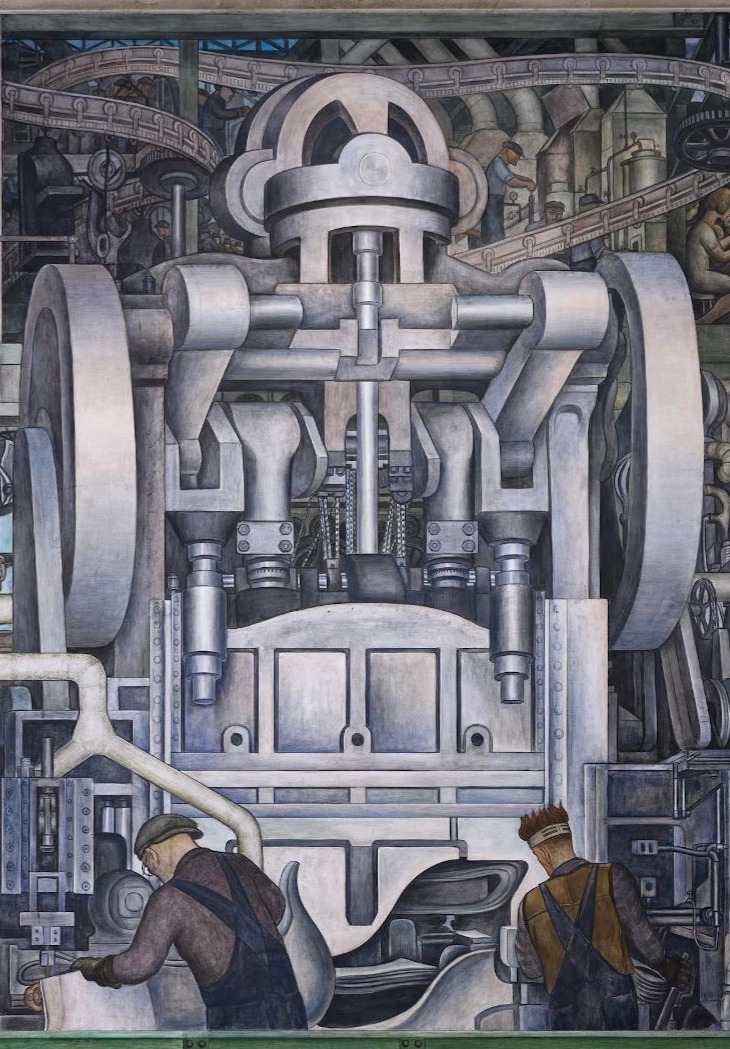
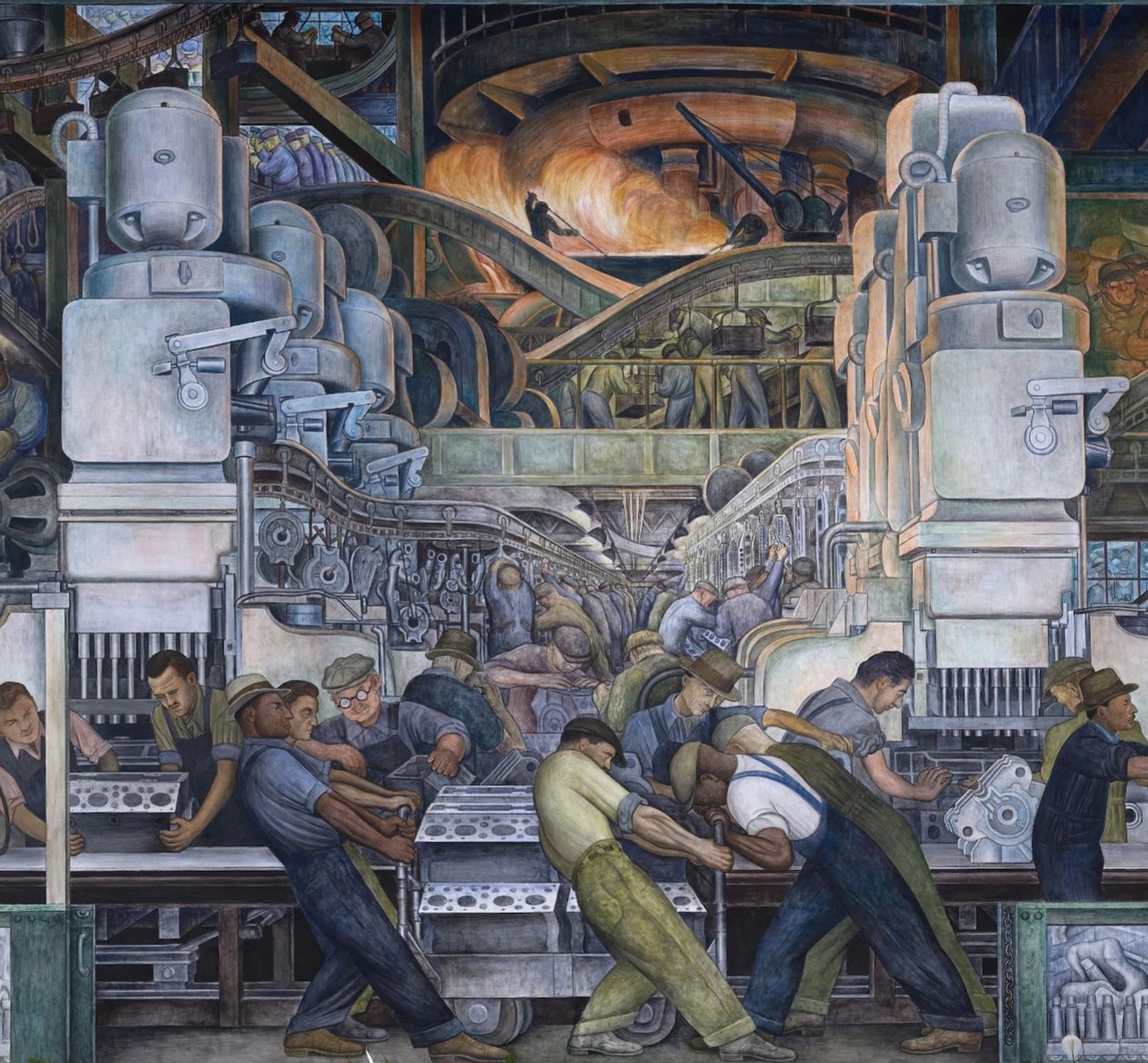
Left: A stamping press resembles Coatlicue, the Aztec goddess of creation and war. Right: Towering multi-spindle machines echo the forms of Toltec warrior statues.
5. Rivera’s Name Is Everywhere: Five Hidden Signatures
Such a massive artwork requires more than one artist’s signature, right?
The easiest signatures to spot appear near an engine block in the lower left corner of the North Wall and near a worker on the lower left panel of the West Wall. Two more may require binoculars to find: one on the pharmaceutical industry panel near the left hand of the chemist/manager on the South Wall, and another below the vaccination panel in the wave-like forms beneath the embryo.
The final signature is only visible from the catwalk high above Rivera Court. It appears on the East Wall near the feet of a female figure, but a projecting ledge blocks it from view from the floor.

One of Rivera's five signatures is on the lower left corner of the North Wall.
These murals mattered deeply to the workers they depict. “In a late-life interview, Rivera said that the most important thing for him personally, in creating this mural cycle, was to depict the worker with respect and dignity and show the spirit and energy of labor,” Gimpel says. “In the ’30s, when Detroit labor came into this room, it was such an important moment. You have to keep in mind the historical context—it was right at the beginning of unionization. They came into this fancy schmancy art museum and saw themselves on the walls treated with such respect and dignity. It was really an important moment.”
So the next time you’re in Rivera Court—whether it’s your first visit or your 100th—use this list as a fun scavenger hunt and see what new details you discover. And if you have questions, one of the museum’s knowledgeable docents is always nearby, ready to share even more stories hidden in the murals.
Want to know more? Check out eight short audio tours on Bloomberg Connects, available online and via their free app.

Diego Rivera's Detroit
Perspectives from a DIA curator, docent, and Ford auto worker