Art is an act of resistance. Art is telling the truth, laying it bare, and stirring up discomfort—allowing it to serve as a teacher. Art is a refusal to remain quiet.
That refusal is at the heart of Contemporary Anishinaabe Art: A Continuation, on view through April 5 at the Detroit Institute of Arts. Through works in mediums ranging from ceramics to textiles, artists confront boarding schools, forced sterilization, and the crisis of Murdered and Missing Indigenous Persons (MMIP). The effects of these traumas linger across generations.
Such is the case for Holly Trevan’s family, who has passed down the story of her grandfather, great aunt, and other Pottawatomi relatives who were sent away to a boarding school in Mount Pleasant, Michigan. Like many other Native American children, they were forcibly removed from their families. “These boarding schools were set up by the government to strip them of identity, their culture, their language, their religion,” Trevan says.
Through oral histories, Trevan knows that her grandfather tried to escape and was handcuffed in the school’s basement. This happened to little boys a lot, Trevan says, and her Aunt Martha witnessed the abuse and decided to do something about it.
“In 1899, when the school was closed for the night, Martha took kerosene rags and attempted to burn the school down. She was 14. She felt like this was the only way they could be set free. That was her logic.” Martha confessed to federal arson and spent some time in prison.
Over 220 children died during the 40 years that school was in operation. “There wasn't a playground—there was a cemetery,” Trevan says.
With no known photographs of her aunt, Trevan took a black and white portrait of her young niece with a “rage of resistance in her eyes.” Zibé was captured using an intentional long exposure, combining a contemporary digital negative with 19th-century printing processes and finished with a coating of melted wax. “It's a story of resilience and a story of resistance—one that is omitted from US history.”
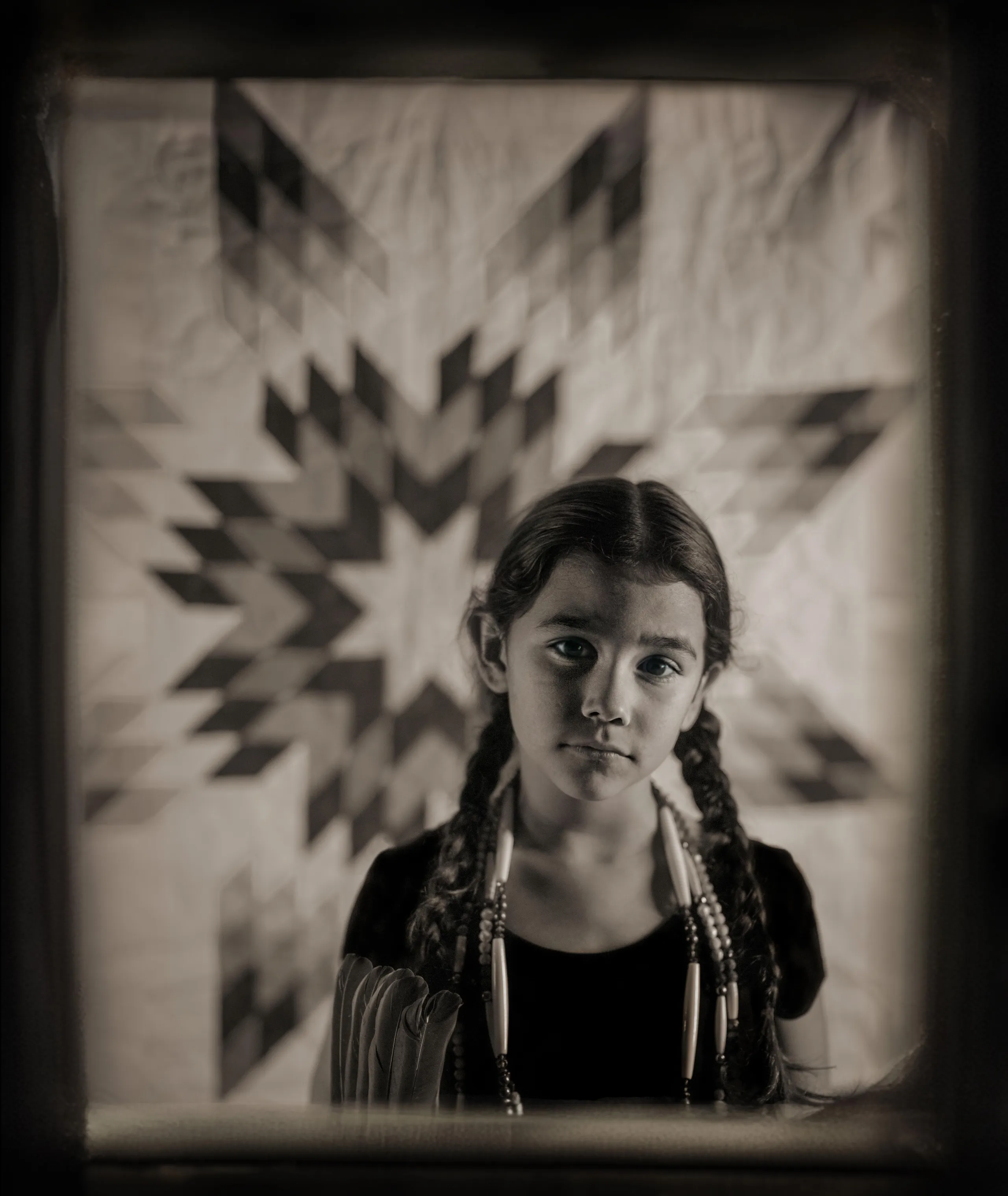
Holly Trevan (Match-E-Be-Nash-She-Wish Band of Pottawatomi), Zibé, 2024. Courtesy of the artist
Another suppressed part of our country’s history, forced sterilization, is not so easily forgotten for artist Patrick Collins. As a young teen in the 1930s, his grandmother, along with her younger sisters, fled from mid-Michigan to relatives in Canada to avoid forced sterilization. In Healing Hands, Collins uses water as a symbol of her healing process during the escape. Girls in this community, he says, were subjected to invasive procedures, including complete hysterectomies. “I didn't put her face in this painting because she wasn't the only one who faced that. Hopefully this makes its way into conversation.”
According to a 2016 PBS report, federally-funded sterilization programs—designed to control populations deemed “undesirable,” including people of color, Indigenous communities, immigrants, the poor, unmarried mothers, and people with disabilities—operated in 32 states throughout the 20th century.
In the case of Native Americans, these practices continued into the 1970s and 1980s, with documented cases of young women receiving tubal ligations during unrelated procedures such as appendectomies. Some studies estimate that between 25 and 50 percent of Native American women were sterilized between 1970 and 1976.
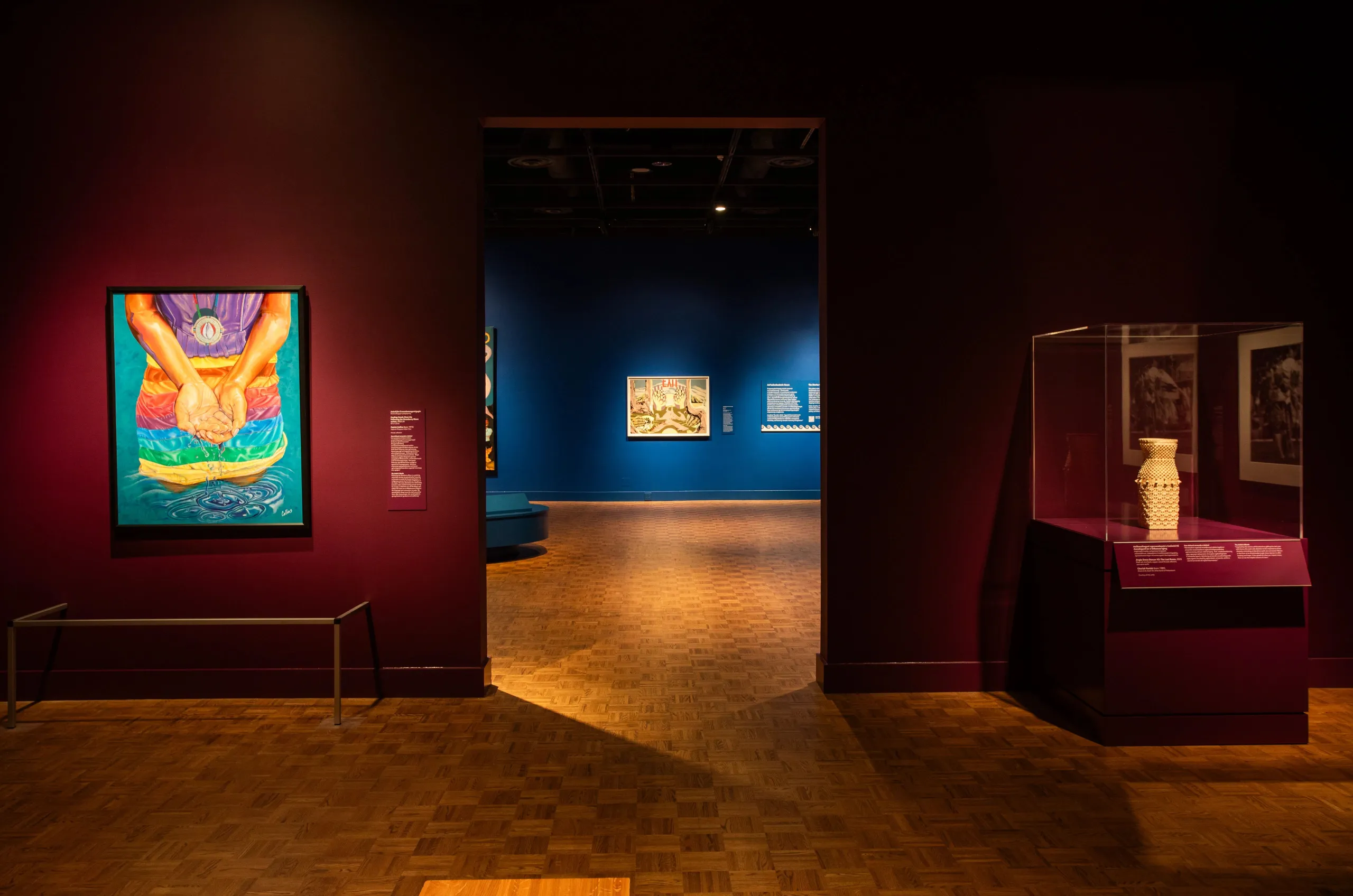
Contemporary Anishinaabe Art: A Continuation exhibit, featuring Healing Hands by Patrick Collins (left)
Works throughout Contemporary Anishinaabe Art bring attention to an issue that remains painfully urgent: the Missing and Murdered Indigenous Persons (MMIP) movement. A 2016 National Institute of Justice study found that four in five American Indian and Alaska Native women have experienced violence in their lifetime, and that same year 5,712 women and girls were reported missing. The Centers for Disease Control and Prevention reported in 2023 that homicide was the fourth leading cause of death for American Indian and Alaska Native males ages 1–44 and the sixth leading cause for females. Since 2017, May 5 has been observed as Missing and Murdered Indigenous Persons Awareness Day.
Within the Contemporary Anishinaabe Art exhibition, visitors will find works like Marcella Hadden’s low-light portrait of her granddaughter draped in a red. Hadden shared the image on social media and asked if anyone would like a similar photo of themselves. Requests came in from almost 100 women, some with relatives who were missing or murdered. “A red dress or red handprint on the face shows solidarity,” Hadden says. “I chose the contrast of red against the black backdrop to make a dramatic expression.”
Also in the exhibition is Nonamey’s Dress for Nookomis, a work that embodies remembrance as both personal and political. The red dress created from acrylic on reclaimed fabric is “an offering, a remembrance, and a demand for justice,” Nomaney says. “It is for my grandmother, Geraldine Rose Crowe. Her story is one of too many, she is one of the Missing and Murdered Indigenous Relatives (MMIR). It is painted as if it exists between worlds—part textile, part memory, part protest.”

Contemporary Anishinaabe Art: A Continuation exhibit, featuring Nonamey's Dress for Nookomis (right)
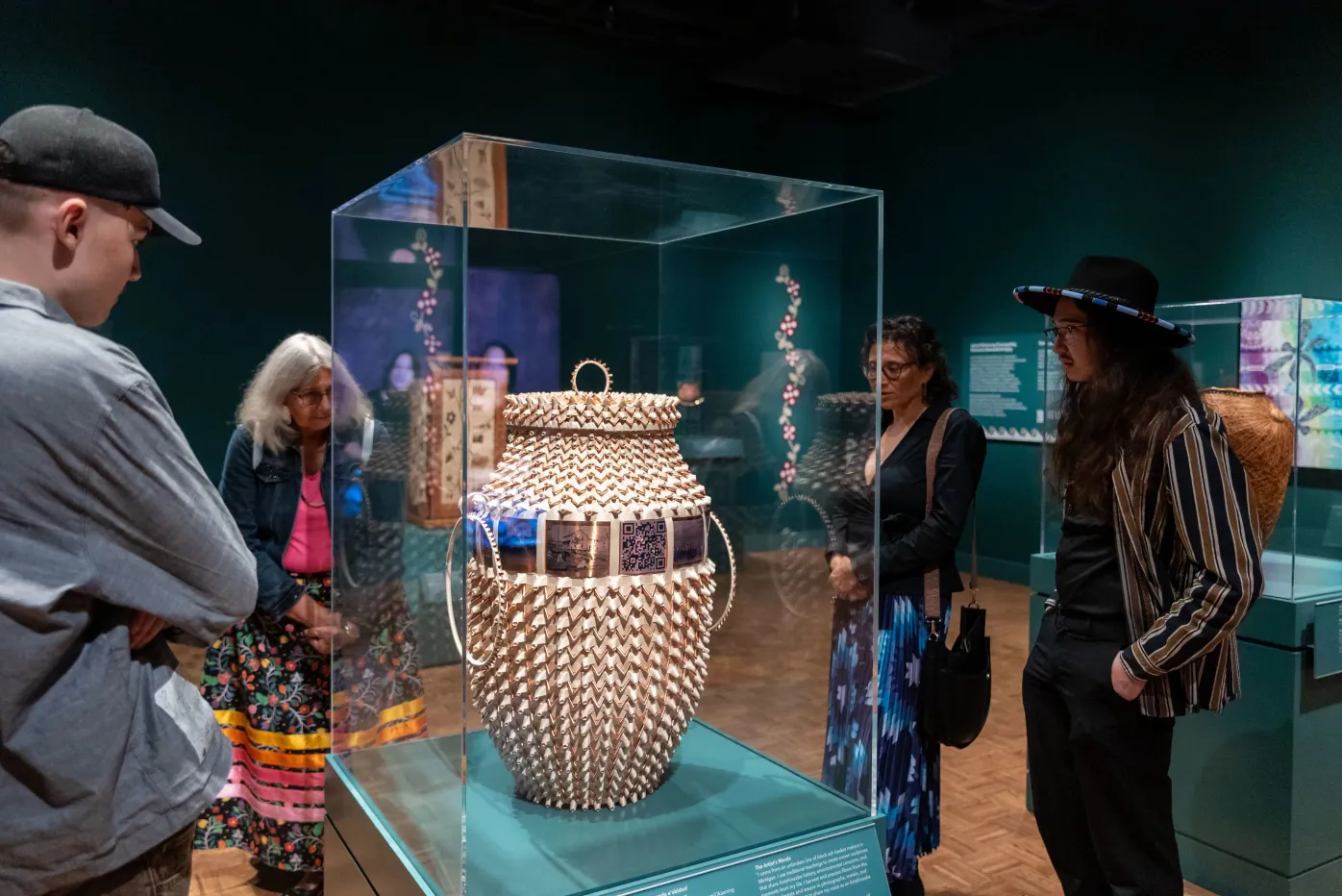
Elsewhere in Contemporary Anishinaabe Art, works such as Shirley Brauker’s Red Hands pottery and Kelly Church’s handwoven black ash basket, Every Picture Tells a Story, extend these conversations—holding memory and protest in forms that ask viewers to look closely and listen.
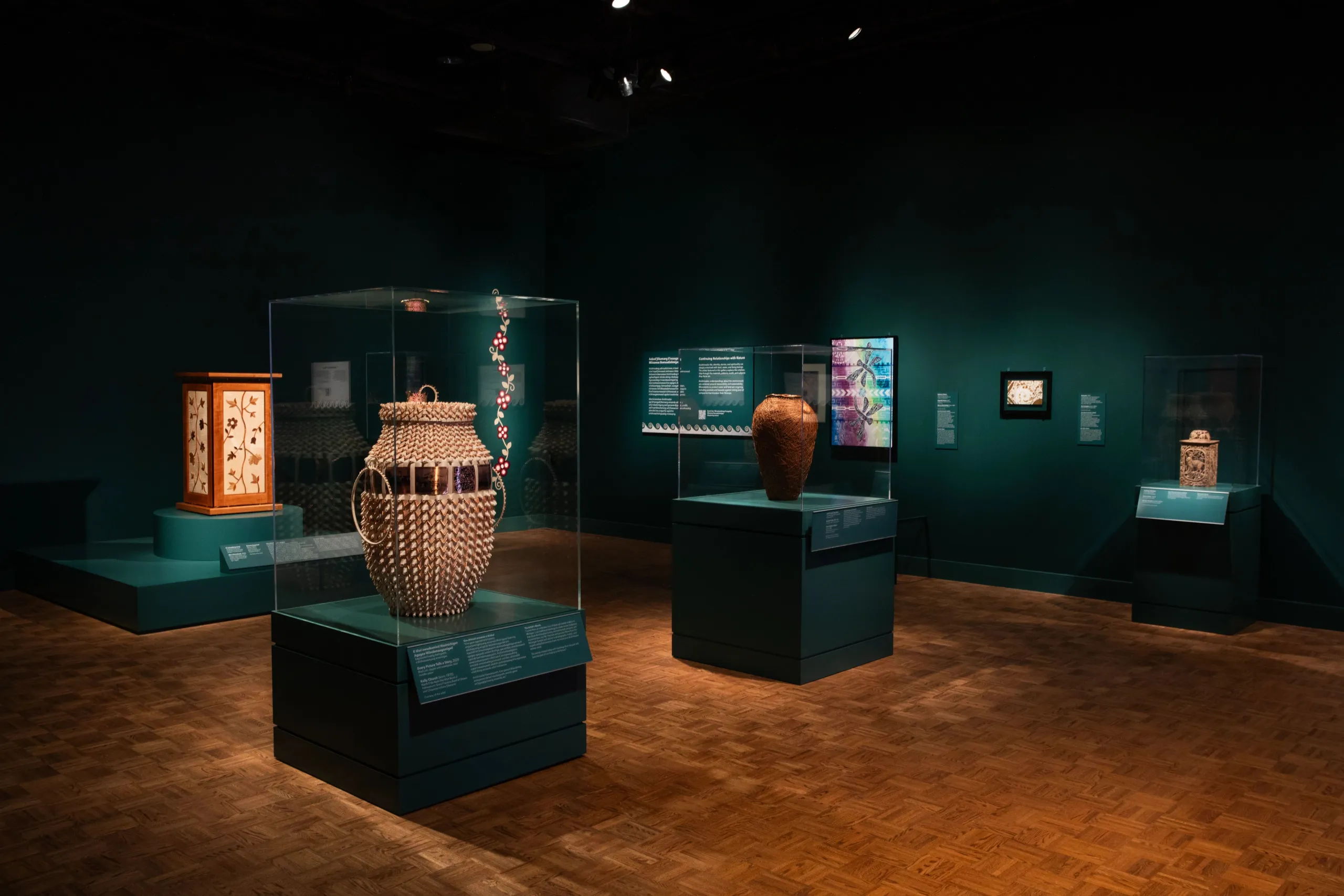
Contemporary Anishinaabe Art: A Continuation exhibit, featuring Kelly Church's black ash basket Every Picture Tells a Story (front, left)